Walking meditation, pilgrimage, prostration practices such as "three steps, one bow" or "one step, one bow" are long-standing traditions in Buddhism. In Tibet, practitioners still perform one-step-one-bow daily, make annual circumambulations of the Potala Palace in Lhasa, or undertake pilgrimages around the sacred Mount Kailash. The venerable monk Hsu Yun once completed a three-steps-one-bow pilgrimage of more than 3,000 kilometers to Mount Wutai. More recently, the monk Minh Tuệ has walked the entire length of Vietnam six times. In Vietnam and other Asian Buddhist countries, such practices are commonplace. In Europe and North America, however, the context is vastly different and far more challenging.
In Europe and the United States, the overwhelming majority of the population adheres to Christianity or Protestant denominations, and relatively few people are familiar with Buddhism. Buddhism in the West has largely remained within academic and intellectual circles. As a result, the public practice of Buddhist traditions in open spaces across Europe and North America has long posed significant social and cultural challenges. More than a decade ago, Vietnamese monks undertook walking pilgrimages for peace and encountered ridicule, verbal abuse, and even harassment from some Western onlookers. Local authorities along their routes neither obstructed nor supported them, remaining largely indifferent. This time, the response has been markedly different. Buddhist monks walking for peace have been met with an outpouring of public enthusiasm nationwide. Local governments have offered full support. Mainstream media outlets have reported extensively, while social media platforms are flooded with positive coverage. Monks from Laos, Vietnam, Cambodia, and Sri Lanka have carried out a remarkable mission—bringing fresh spiritual energy and spreading messages of love, unity, and compassion throughout the communities they pass.
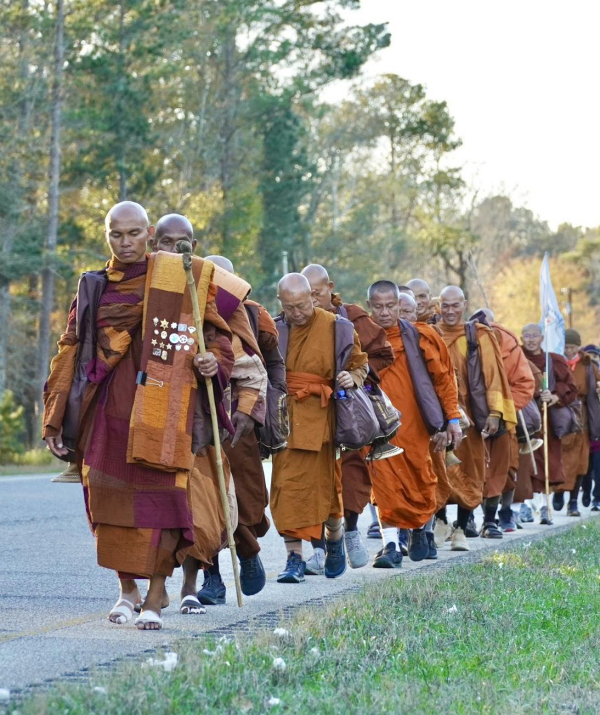
Nineteen monks, led by Venerable Bhikkhu Pannakara, departed from Huong Dao Monastery (Vipassana Bhavana Center) in Fort Worth, Texas, on October 26, 2025, beginning their Walk for Peace. Their journey is expected to conclude in Washington, D.C., on February 13, 2026. The route spans ten states—Texas, Louisiana, Mississippi, Alabama, Georgia, South Carolina, North Carolina, Virginia, and Maryland—covering a total distance of 2,300 miles (3,680 kilometers). The monks walk through freezing conditions, with temperatures on some days dropping below zero. Accompanying them is Aloka, a dog originally from India. After once encountering the monks during a pilgrimage in India, Aloka followed them faithfully, survived an accident, was rescued, and has since remained inseparable from the group. The monks’ journey for peace has generated a powerful emotional response across the United States. A white flag bearing a dove and the slogan “Walk for Peace,” alongside the message “Peace is not a destination, but a daily practice within each individual,” has spread widely across American communities.
At a time when the United States is grappling with a profound crisis of trust and morality—deeply divided by hatred and racial animosity stirred by extremist forces—the presence of Buddhist monks walking for peace has brought a rare sense of healing. Fox 5 described the pilgrimage as delivering a “symbolic message of healing and renewal.” Wherever the monks pass—across plains and riverbanks, villages and towns, cities and metropolitan centers—they are greeted with warmth and joy. Local police departments have worked tirelessly to escort the monks and ensure security. Mayors, police chiefs, lawmakers, and public officials have come to city borders to welcome them. Residents line the roads offering flowers and food. Many Americans have been moved to tears. Thousands cheer as the monks pass. Some clasp their hands in reverence like devout Buddhists. The monks have created an unprecedented event in this new land.
From the very beginning of the journey, I harbored concerns that the monks might encounter hostility, given the differences in faith and the current climate of racial division and intolerance. Fortunately, those fears proved unfounded. Instead, Americans poured into the streets to welcome the monks with an extraordinary level of joy and reverence rarely seen before.
When the monks arrived in DeKalb County on a Monday—a regular workday—thousands of people lined highways 85, 138, and the streets of Jonesboro to greet them. That evening, Southlake Mall, a vast complex spanning hundreds of thousands of square feet, was filled to capacity. More than ten thousand people gathered in anticipation and celebration. Many teenagers brought flowers to offer the monks. As the crowd continued to grow, police were forced to close off entrances to the mall. I witnessed a sea of people—young and old, men and women, white, Black, brown, and Asian—standing shoulder to shoulder, waiting to see and hear the monks speak. John Lampl, the mayor of Morrow, a generous and compassionate leader, provided full support for welcoming the monks and for Vietnamese cultural activities in the area.
Along the way, the monks bless local residents, visit government buildings and communities at the invitation of local authorities, and engage in conversations with the public during rest stops. A colleague of mine, Veronica, proudly showed me a blessed bracelet she received from the monks and asked about its meaning. I explained that it symbolized blessings for peace of body and mind, protection from the Three Jewels, and favorable conditions in life—what many would call good fortune. Simply encountering the monks and receiving their blessing was already a form of good fortune. She then asked why, in such bitter cold, some monks walked barefoot. I answered as best I could: walking barefoot represents letting go, reducing dependence on material comforts. Human suffering, Buddhism teaches, arises from attachment and clinging; liberation comes through release.
As I spoke, I felt deeply moved and filled with admiration. In such freezing weather, we remain indoors with heating, layered clothing, shoes, scarves, and hats—yet still complain of the cold. Meanwhile, the monks walk on, some barefoot, heads uncovered. Their saffron and ochre robes glow against the bleak winter landscape. Though physically small in stature compared to Americans, they possess immense inner strength and resolve. They walk swiftly, with calm and joy, smiling and waving to those along the roadside. Aloka’s presence only amplifies public fascination and affection.
Each day, the monks cover an average of 30 miles (46 kilometers). Reaching Georgia marks the halfway point of their journey. From there to Washington, D.C., the challenges intensify as the weather grows colder and harsher. Yet while the climate is unforgiving, the warmth of the people remains abundant. The road ahead holds many obstacles, but the monks will surely arrive in Washington in peace. Their walk for peace has truly brought peace into the hearts of the communities they pass through.
Thiên tài là khả năng hiện thực hóa những điều bạn nghĩ. (Genius is the ability to put into effect what is on your mind. )F. Scott Fitzgerald
 Trang chủ
 Xem Mục lục








 Viên Hiếu Thành
  Đá banh vì quê nhà
 Giới thiệu Trường Cao đẳng Phật giáo Thực dụng
 17. Biện minh chỗ chí đạo trong Tam giáo
 11. Bà Dương Thị Thu (1948 - 1996)