Bạn có thể lừa dối mọi người trong một lúc nào đó, hoặc có thể lừa dối một số người mãi mãi, nhưng bạn không thể lừa dối tất cả mọi người mãi mãi. (You can fool all the people some of the time, and some of the people all the time, but you cannot fool all the people all the time.)Abraham Lincoln


Chúng ta không thể đạt được sự bình an nơi thế giới bên ngoài khi chưa có sự bình an với chính bản thân mình. (We can never obtain peace in the outer world until we make peace with ourselves.)Đức Đạt-lai Lạt-ma XIV
Muôn việc thiện chưa đủ, một việc ác đã quá thừa.Tủ sách Rộng Mở Tâm Hồn
Kẻ không biết đủ, tuy giàu mà nghèo. Người biết đủ, tuy nghèo mà giàu. Kinh Lời dạy cuối cùng
Cỏ làm hại ruộng vườn, tham làm hại người đời. Bố thí người ly tham, do vậy được quả lớn.Kinh Pháp Cú (Kệ số 356)
Chúng ta không có quyền tận hưởng hạnh phúc mà không tạo ra nó, cũng giống như không thể tiêu pha mà không làm ra tiền bạc. (We have no more right to consume happiness without producing it than to consume wealth without producing it. )George Bernard Shaw
Chúng ta trở nên thông thái không phải vì nhớ lại quá khứ, mà vì có trách nhiệm đối với tương lai. (We are made wise not by the recollection of our past, but by the responsibility for our future.)George Bernard Shaw
Các sinh vật đang sống trên địa cầu này, dù là người hay vật, là để cống hiến theo cách riêng của mình, cho cái đẹp và sự thịnh vượng của thế giới.Đức Đạt-lai Lạt-ma XIV
Khi mọi con đường đều bế tắc, đừng từ bỏ. Hãy tự vạch ra con đường của chính mình. (When all the ways stop, do not give up. Draw a way on your own.)Sưu tầm
Nếu muốn có những điều chưa từng có, bạn phải làm những việc chưa từng làm.Sưu tầm
Tôi không thể thay đổi hướng gió, nhưng tôi có thể điều chỉnh cánh buồm để luôn đi đến đích. (I can't change the direction of the wind, but I can adjust my sails to always reach my destination.)Jimmy Dean
 Trang chủ
Trang chủ »» Danh mục »» TỦ SÁCH RỘNG MỞ TÂM HỒN »» The Buddha's Teachings on Social and Communal Harmony »» none »»
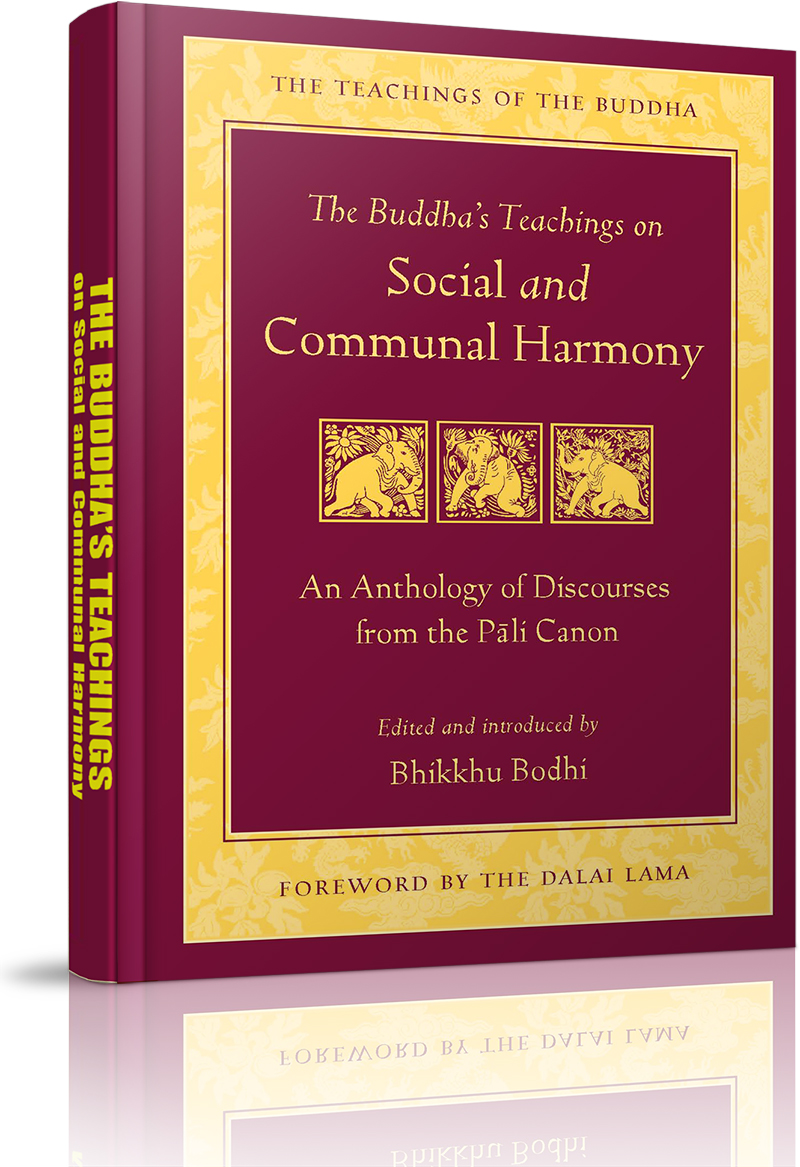
The Buddha's Teachings on Social and Communal Harmony
»» none
 Xem Mục lục






- About Bhikkhu Bodhi
- Foreword by His Holiness The Dalai Lama
- »» none
- General Introduction
- I. RIGHT UNDERSTANDING
- II. PERSONAL TRAINING
- III. DEALING WITH ANGER
- IV. PROPER SPEECH
- V. GOOD FRIENDSHIP
- VI. ONE’S OWN GOOD AND THE GOOD OF OTHERS
- VII. THE INTENTIONAL COMMUNITY
- VIII. DISPUTES
- IX. SETTLING DISPUTES
- X. ESTABLISHING AN EQUITABLE SOCIETY
- Epilogue BY HOZAN ALAN SENAUKE



Gotama Buddha came of age in a land of kingdoms, tribes, and varna, meaning social class or caste. It was a time and place both distinct from and similar to our own, in which a person’s life was strongly determined by social status, family occupation, cultural identity, and gender. Before the Buddha’s awakening, identity was definitive. If one was born into a warrior caste or that of a merchant or a farmer or an outcast, one lived that life completely and almost always married someone from the same class or caste. One’s children did the same. There was no sense of individual rights or personal destiny, no way to manifest one’s human abilities apart from a societal role assigned at birth. So the Buddha’s teaching can be seen as a radical assertion of individual potentiality. Only by one’s effort was enlightenment possible, beyond the constraints of caste, position at birth, or conventional reality. In verse 396 of the Dhammapada, the Buddha says:
I do not call one a brahmin only because of birth, because he is born of a (brahmin) mother. If he has attachments, he is to be called only “self-important.” One who is without attachments, without clinging — him do I call a brahmin.
At the same time, the Buddha and his disciples lived in the midst of society. They didn’t set up their monasteries on isolated mountaintops but on the outskirts of large cities such as Sāvatthī, Rājagaha, Vesālī, and Kosambī. They depended on laywomen and men, upāsikā and upāsaka, for the requisites of life. Even today monks and nuns in the Theravāda tradition of Burma (or Myanmar), Thailand, Sri Lanka, Cambodia, and Laos go on morning alms rounds for their food. Although they keep a strict monastic discipline, it is mistaken to imagine that Southeast Asian monasteries are cloistered and apart from their brothers and sisters in the secular world. Monasteries and secular communities are mutually dependent, in a tradition that is sweet and fully alive.
In the autumn of 2007 people around the world were inspired by Burma’s determined yet peaceful “Saffron Revolution” — led by a nonviolent protest of Burmese monks against the military government’s repression.
The protests were triggered by sudden and radical increases in fuel prices that drastically affected people’s ability to get to work or to afford fuel for cooking or even basic foods. The intimate connection between monks, nuns, and laypeople has historically meant that when one sector is suffering, the other responds. Burmese monks have a long history of speaking out against injustice. They have been bold in opposition to British colonialism, dictatorship, and two decades of a military junta.
In Burma Buddhist monks have been agents of change in a society that stands on the brink of real transformation. While this change is inevitable, the military junta had previously resisted it with grim determination. A confluence of circumstances created an opening: the election of a new civilian government (however one might question the electoral process), the release of political prisoners (including Nobel laureate Daw Aung San Suu Kyi after many years of house arrest), nonviolent movements around the world encouraged by 2011’s “Arab Spring,” and a new dialogue between Burma’s leaders and representatives from Europe, the United States, and other economic powers. There was a feeling of possibility and hope in the air.
This anthology underscores living within the Dhamma in a free and harmonious society, using the Buddha’s time-tested words. Returning from Burma in November of 2011, I had been thinking about the need there and elsewhere for this kind of collection from the Pāli suttas. In 2012 communal violence erupted in Burma’s Rakhine State and elsewhere in that country. A need to look deeply into the Buddha’s teachings on social harmony has become urgent. Not being a scholar or a translator, I contacted several learned friends. It turns out that several years back Bhikkhu Bodhi, one of our most respected and prolific interpreters of Early Buddhism, had assembled such a collection as an addendum to a training curriculum for social harmony in Sri Lanka, organized by the Institute for the Study of Human Rights at Columbia University.
Here is the Buddha’s advice about how to live harmoniously in societies that are not oppressing those of different religions or ethnic backgrounds, not savaging and exploiting themselves or others. While circumstances in Burma, Sri Lanka, Thailand, India, or the United States vary, the Buddha’s social teachings offer a kind of wisdom that transcends the particularities of time and place. His teachings provide a ground of liberation upon which each nation and people can build according to its own needs.
I am most grateful to Bhikkhu Bodhi for his wisdom and generosity. People of all faiths and beliefs in every land yearn for happiness and liberation. I honor those who move toward freedom, and hope that the Buddha’s words on social harmony may lead us fearlessly along our path.
Berkeley, CA
___________________
Acknowledgments
In 2011 Bhikkhu Khemaratana shared with me an outline of texts from the Pāli Canon that he had prepared on the theme of monastic harmony, a topic in which he has been particularly interested. The texts that I have chosen for several sections of this anthology were suggested by those selected by Ven. Khemaratana, though my treatment of the topic has been governed by the purpose of this anthology and thus differs from his outline. I am also grateful to Alan Senauke for writing a prologue and epilogue to this volume, drawing upon his own experience using the earlier version of this anthology in his work of fostering social harmony and reconciliation in India and Myanmar.
TỪ ĐIỂN HỮU ÍCH CHO NGƯỜI HỌC TIẾNG ANH
DO NXB LIÊN PHẬT HỘI PHÁT HÀNH


BẢN BÌA CỨNG (HARDCOVER)
1200 trang - 54.99 USD

BẢN BÌA THƯỜNG (PAPERBACK)
1200 trang - 45.99 USD


BẢN BÌA CỨNG (HARDCOVER)
728 trang - 29.99 USD

BẢN BÌA THƯỜNG (PAPERBACK)
728 trang - 22.99 USD
Mua sách qua Amazon sẽ được gửi đến tận nhà - trên toàn nước Mỹ, Canada, Âu châu và Úc châu.
Quý vị đang truy cập từ IP 216.73.216.157 và chưa ghi danh hoặc đăng nhập trên máy tính này. Nếu là thành viên, quý vị chỉ cần đăng nhập một lần duy nhất trên thiết bị truy cập, bằng email và mật khẩu đã chọn.
Chúng tôi khuyến khích việc ghi danh thành viên ,để thuận tiện trong việc chia sẻ thông tin, chia sẻ kinh nghiệm sống giữa các thành viên, đồng thời quý vị cũng sẽ nhận được sự hỗ trợ kỹ thuật từ Ban Quản Trị trong quá trình sử dụng website này.
Việc ghi danh là hoàn toàn miễn phí và tự nguyện.
Ghi danh hoặc đăng nhập
 Viên Hiếu Thành Huệ Lộc 1959 Bữu Phước Chúc Huy Minh Pháp Tự minh hung thich Diệu Âm Phúc Thành Phan Huy Triều Phạm Thiên Trương Quang Quý Johny Dinhvinh1964 Pascal Bui Vạn Phúc Giác Quý Trần Thị Huyền Chanhniem Forever NGUYỄN TRỌNG TÀI KỲ Dương Ngọc Cường Mr. Device Tri Huynh Thích Nguyên Mạnh Thích Quảng Ba T TH Tam Thien Tam Nguyễn Sĩ Long caokiem hoangquycong Lãn Tử Ton That Nguyen ngtieudao Lê Quốc Việt Du Miên Quang-Tu Vu phamthanh210 An Khang 63 zeus7777 Trương Ngọc Trân Diệu Tiến ... ...
 ... ...